Search This Blog

C Program Using 8086 Interrupts to Restrict Mouse Pointer Into a Circle of Given Center and Radius

C Program Using 8086 Interrupts to Restrict Mouse Pointer Into a Circle of Given Center and Radius. The mouse ponter will be restricted to a circle of user specified center and radius using the interrupt 33 of 8086 in c complier. I have tested this program in Turbo C compiler.
How to restrict mouse cursor or pointer within a user specified circle Using 8086 INT33 service interrupts arrow mice radius centre Turbo c program Turbo C++ code source code without thread screen rectangle
Mouse pointer restricted into a circle in Turbo C


#include<stdio.h>
#include<conio.h>
#include<dos.h>
#include<graphics.h>

void main()
{
int x,y,tx,ty,r;
union REGS inreg, outreg;
/* request auto detection */
int gdriver = DETECT, gmode, errorcode;
clrscr();
/* initialize graphics and local variables */
initgraph(&gdriver, &gmode,"C:\\TC\\BGI\\" );
/* read result of initialization */
errorcode = graphresult();
if (errorcode != grOk) /* an error occurred */
{
printf("Graphics error: %s\n", grapherrormsg(errorcode));
printf("Press any key to halt:");
getch();
exit(1); /* terminate with an error code */
}
setcolor(getmaxcolor());
printf("\nEnter the center of circle. x and y");
scanf("%d%d",&x,&y);
printf("\nEnter the radius of circle");
scanf("%d",&r);
clrscr();
circle(x,y,r);
inreg.x.ax=0x1;
int86(0x33,&inreg,&outreg);
inreg.x.ax=0x7;
inreg.x.cx=x-r;
inreg.x.dx=x+r;
int86(0x33,&inreg,&outreg);
inreg.x.ax=0x8;
inreg.x.cx=y-r;
inreg.x.dx=y+r;
int86(0x33,&inreg,&outreg);
do
{
inreg.x.ax=0x3;
int86(0x33,&inreg,&outreg);
tx=outreg.x.cx;
ty=outreg.x.dx;
if((tx-x)*(tx-x)+(ty-y)*(ty-y)>r*r)
{
if(tx<=x)
{
if(ty<y)
do{tx++; ty++;}while((tx-x)*(tx-x)+(ty-y)*(ty-y)>=r*r);
else
do{tx++; ty--;}while((tx-x)*(tx-x)+(ty-y)*(ty-y)>=r*r);
}
else
{
if(ty<=y)
do{tx--; ty++;}while((tx-x)*(tx-x)+(ty-y)*(ty-y)>=r*r);
else
do{tx--; ty--;}while((tx-x)*(tx-x)+(ty-y)*(ty-y)>=r*r);
}
inreg.x.ax=0x4;
inreg.x.cx=tx;
inreg.x.dx=ty;
int86(0x33,&inreg,&outreg);
}
}while(1);
}

C Program to Display and Set System Time and Date Using 8086 Interrupts

This is a C Program to Display and Set System Time and Date Using 8086 Interrupts. Interrupt number 21 (in hexadecimal) is used to:
C program to get system time and date and also to set it using 8086 interrupt INT 21 interrupt 0x21 21h int86() function call interrupts in C program
Output of c Program to get and set system time and date 

  • Get System time
  • Set System time
  • Get System Date
  • Set System Date
To Get system date:
- Call interrupt 0x21 (hexadecimal) 
- AH (higher byte of accumulator) should be made equal to 2A (hex) before calling interrupt
Output:


  • day in DL
  • Month in DH
  • Year in CX

To set System Date:

- Call interrupt 0x21 (hexadecimal) 
- AH (higher byte of accumulator) should be made equal to 2B (hex) before calling interrupt
- Before Calling interrupt, store:
  • Year in CX
  • Month in DH
  • Day in DL
To Get system time:
- Call interrupt 0x21 (hexadecimal) 
- AH (higher byte of accumulator) should be made equal to 2C (hex) before calling interrupt
Output:
  • Hours in CH
  • Minutes in CL
  • Seconds in DH
  • 1/100 th of a second in DL


To set System Time:


- Call interrupt 0x21 (hexadecimal) 


- AH (higher byte of accumulator) should be made equal to 2D (hex) before calling interrupt

- Before Calling interrupt, store:


  • Hour in CH 

  • Minutes in CL

  • Seconds in DH 

  • 1/100 th of second in DL


#include<stdio.h>
#include<dos.h>
#include<conio.h>

void main()
{
int day,month,year,tflag=0,dflag=0,hr,min,sec;
union REGS inreg,outreg;
DISDATE:printf("\nCurrent date:\n");
inreg.h.ah=0x2a;
int86(0x21,&inreg,&outreg);
printf("%d-%d-%d ",outreg.h.dl,outreg.h.dh,outreg.x.cx);
switch(outreg.h.al)
{
case 0:printf("Sunday");break;
case 1:printf("Monday");break;
case 2:printf("Tueday");break;
case 3:printf("Wednesday");break;
case 4:printf("Thursday");break;
case 5:printf("Friday");break;
case 6:printf("Sunday");break;
}
if(dflag==1)
goto SETTIME;
DISTIME:printf("\nCurrent Time:\n");
inreg.h.ah=0x2c;
int86(0x21,&inreg,&outreg);
printf("%d:%d:%d.%d ",outreg.h.ch,outreg.h.cl,outreg.h.dh,outreg.h.dl);
if(tflag==1)
goto END;
SETDATE:printf("\nSet Date.\nDay,Month and Year\n");
scanf("%d%d%d",&day,&month,&year);
inreg.h.ah=0x2b;
inreg.x.cx=year;
inreg.h.dh=month;
inreg.h.dl=day;
int86(0x21,&inreg,&outreg);
if(outreg.h.al==0x00)
{
dflag=1;
goto DISDATE;
}
else
{
printf("\nInvalid entry");
getch();
exit(0);
}
SETTIME:printf("\nSet Time. Enter Time.\nHour,Minutes and Seconds\n");
scanf("%d%d%d",&hr,&min,&sec);
inreg.h.ah=0x2d;
inreg.h.ch=hr;
inreg.h.dh=sec;
inreg.h.cl=min;
inreg.h.dl=0;
int86(0x21,&inreg,&outreg);
if(outreg.h.al==0x00)
{
tflag=1;
goto DISTIME;
}
else
{
printf("\nInvalid entry");
getch();
exit(0);
}
END: getch();
}

C Program To Implement Circular Linked List

C Program to implement circular linked list.

c program to implement circular linked list c or c++ program source code for linked list implementation with example


#include<stdio.h>
#include<malloc.h>
#include<stdlib.h>

struct node
{
int info;
struct node *link;
}*last;
void create_list(int num);
void addatbeg(int num);
void addafter(int num,int pos);
void del(int num);
void display();
void main()
{
int choice,n,m,po,i;
last=NULL;
while(1)
{
printf("1.Create List\n");
printf("2.Add at begining\n");
printf("3.Add after \n");
printf("4.Delete\n");

printf("5.Display\n");
printf("6.Quit\n");
printf("Enter your choice : ");
scanf("%d",&choice);

switch(choice)
{
case 1: printf("How many nodes you want : ");
scanf("%d",&n);
for(i=0; i < n;i++)
{
printf("Enter the element : ");
scanf("%d",&m);
create_list(m);
}
break;
case 2: printf("Enter the element : ");
scanf("%d",&m);
addatbeg(m);
break;
case 3: printf("Enter the element : ");
scanf("%d",&m);
printf("nter the position after which this element is inserted: ");
scanf("%d",&po);
addafter(m,po);
break;
case 4: if(last == NULL)
{
printf("List underflow\n");
continue;
}
printf("Enter the number for deletion : ");
scanf("%d",&m);
del(m);
break;
case 5: display();
break;
case 6: exit(0);
default:printf("Wrong choice\n");
}
}
}
void create_list(int num)
{
struct node *temp;
temp=(node*)malloc(sizeof(struct node));
temp->info = num;
if(last == NULL)
{
last = temp;
temp->link = last;
}
else
{
temp->link = last->link;
last->link = temp;
last = temp;
}
}

void addatbeg(int num)
{
struct node *temp;
temp =(node*)malloc(sizeof(struct node));
temp->info = num;
temp->link = last->link;
last->link = temp;
}
void addafter(int num,int pos)
{
struct node
*temp,*q;
int i;
q = last->link;
for(i=0;i<pos-1;i++)
{
q = q->link;
if(q==last->link)
{
printf("There are less than %d elements\n",pos);
return;
}
}
temp =(node*)malloc(sizeof(struct node) );
temp->link = q->link;
temp->info = num;
q->link = temp;
if(q==last) //Element inserted at the end
last=temp;
}//End of addafter()

void del(int num)
{
struct node *temp,*q;
if( last->link == last && last->info == num) //Only one element
{
temp=last;
last = NULL;
free(temp);
return;
}
q = last->link;
if(q->info == num)
{
temp = q;
last->link = q->link;
free(temp);
return;
}
while(q->link !=last)
{
if(q->link->info==num) //Element deleted in between
{
temp = q->link;
q->link = temp->link;
free(temp);
printf("%d deleted\n",num);
return;
}
q = q->link;
}
if(q->link->info==num) //Last element deleted q->link=last
{
temp = q->link;
q->link = last->link;
free(temp);
last = q;
return;
}
printf("Element %d not found\n",num);
}

void display()
{
struct node *q;
if(last == NULL)
{
printf("List is empty\n");
return;
}
q = last->link;
printf("List is :\n");
while(q != last)
{
printf("%d ", q->info);
q = q->link;
}
printf("%d\n",last->info);
}

C Program For Insertion And Deletion In Heap

C program code for Insertion and Deletion in a Heap.

#include <stdio.h>
#include<stdlib.h>
int arr[100],n;
void display();
void insert(int num,int loc);
void del(int num);

void main()
{
int choice,num;
n=0; //number of nodes in the heap
while(1) //loop for menu
{
printf("1.Insert\n");
printf("2.Delete\n");
printf("3.Display\n");
printf("4.Quit\n");
printf("Enter your choice : ");
scanf("%d",&choice);
switch(choice)
{
case 1:
printf("Enter the number to be inserted : ");
scanf("%d",&num);
insert(num,n);
n=n+1;
break;
case 2:
printf("Enter the number to be deleted : ");
scanf("%d",&num);
del(num);
break;
case 3:
display();
break;
case 4:
exit(0);
default: printf("Wrong choice\n");
}
}
}

void display()
{
int i;
if(n==0)
{
printf("Heap is empty\n");
return;
}
for(i=0;i<n;i++)
printf("%d ",arr[i]);
printf("\n");
}

void insert(int num,int loc)
{
int par;
while(loc>0)
{
par=(loc-1)/2;
if(num<=arr[par])
{
arr[loc]=num;
return;
}
arr[loc]=arr[par];
loc=par;
}
arr[0]=num; //assign num to the root node
}

void del(int num)
{
int left,right,i,temp,par;
for(i=0;i<n;i++)
{
if(num==arr[i])
break;
}
if(num!=arr[i])
{
printf("%d not found in heap\n",num);
return;
}
arr[i]=arr[n-1];
n=n-1;
par=(i-1)/2; //find parent of node i
if(arr[i] > arr[par])
{
insert( arr[i],i);
return;
}
left=2*i+1; //left child of i
right=2*i+2; // right child of i
while(right < n)
{
if(arr[i]>=arr[left] && arr[i]>=arr[right])
return;
if(arr[right]<=arr[left])
{
temp=arr[i];
arr[i]=arr[left];
arr[left]=temp;
i=left;
}
else
{
temp=arr[i];
arr[i]=arr[right];
arr[right]=temp;
i=right;
}
left=2*i+1;
right=2*i+2;
}
if( left==n-1 && arr[i]<arr[left] ) /* right==n */
{
temp=arr[i];
arr[i]=arr[left];
arr[left]=temp;
}
}

C Program To Represent Directed or Undirected Graph Using Adjacency Matrix

C program to represent directed or undirected graph using Adjacency matrix.

#include<stdio.h>
#include<conio.h>
#define max 20
int adj[max][max]; //Adjacency matrix
int n; //Denotes number of nodes in the graph
void main()
{

int max_edges,i,j,origin,destin;
char graph_type;
printf("Enter number of nodes : ");
scanf("%d",&n);
printf("Enter type of graph, directed or undirected.\n");
printf("Enter d for directed and u for undirected:\n ");
fflush(stdin);
scanf("%c",&graph_type);
if(graph_type=='u')
max_edges=n*(n-1)/2;
else
max_edges=n*(n-1);
for(i=1;i<=max_edges;i++)
{
printf("Enter edge %d( 0 0 to quit ) : ",i);
scanf("%d %d",&origin,&destin);
if( (origin==0) && (destin==0) )
break;
if( origin > n || destin > n || origin<=0 || destin<=0)
{
printf("Invalid edge!\n");
i--;
}
else
{
adj[origin][destin]=1;
if( graph_type=='u')
adj[destin][origin]=1;
}
}


printf("The adjacency matrix is :\n");
for(i=1;i<=n;i++)
{
for(j=1;j<=n;j++)
printf("%4d",adj[i][j]);
printf("\n");
}
getch();
}

C Program to Display SCAN and ASCII Codes of Keys on Keyboard Using 8086 Interrupt

output of C program source code to find scan code and ASCII code of any key pressed on keyboard asci ascii A 65 97 32 30 keyboard code using 8086 interrupt 16 0x16 16h INT16 int86 int86x
Output (ASCII and SCAN code) when a is pressed
This program displays SCAN code and ASCII code of any key pressed on the keyboard. We use inregs is made zero in the program. Then interrupt 16h is called using int86() function in dos.h. The arguments are interrupt number (in hexadecimal ; in C 0x16) pointer to input register and pointer to output register.
The interrupt stores scan code in higher byte of accumulator and ASCII code in lower byte of accumulator.

8086 interrupt number 16h (hexadecimal) to read a keystroke from keyboard. The condition for this interrupt is that the higher byte of accumulator (AH) should be 00h.

#include<stdio.h>
#include<dos.h>
#include<conio.h>
void main()
{
union REGS inregs,outregs; //declaring 2 register files
clrscr();
inregs.h.ah=0x0; //pre-requisite for desired operation of interrupt 16h
int86(0x16,&inregs,&outregs); //calling interrupt 16h
printf("\nScan Code :%d\nASCII code:%d\n",outregs.h.ah,outregs.h.al);
getch();
}

C and C++ Compiler For Android Smartphones

In this post i'm listing some C Program compilers for Android phones or tabs. It will be very handy if you have one in your phone if you are a programming student. You don't need to have a laptop or a Personal computer with you.

C4Droid


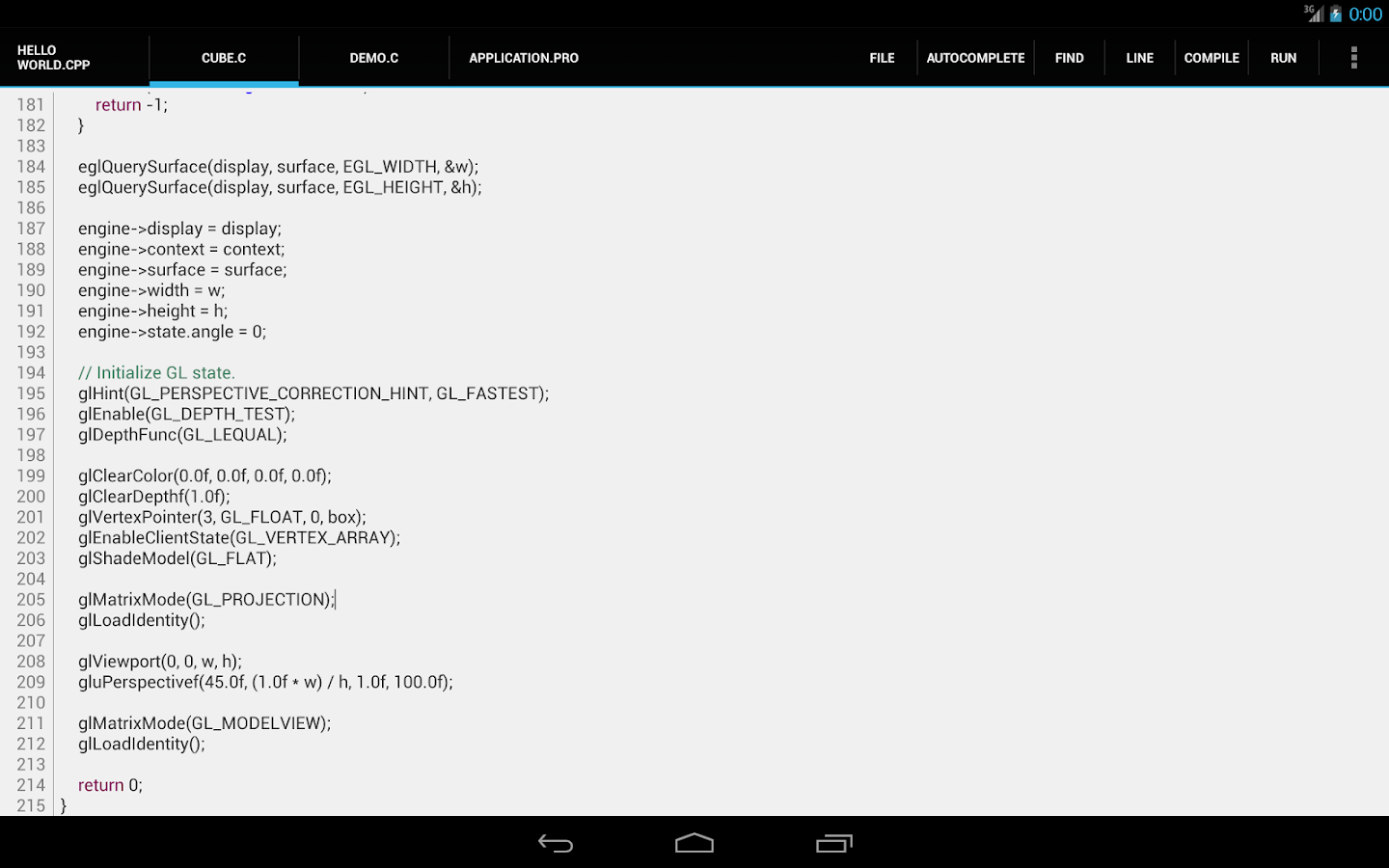
It is a powerful offline C/C++ IDE + C/C++ compiler for Android operating System. I have been using it for 1 year. You do not need to root your phone to use this app. Its features are as listed below:


  • Syntax highlighting
  • Multiple tabs
  • code complete
  • Auto formating
  • Options to export the program as apk or other Executables
  • Full ANSI C and ISO C99 support with TCC (Tiny C Compiler) + uClibc
  • Customizable Graphical User Interface with themes
  • C++ support with GCC+
  • Debugger with breakpoints and watches


C4droid - C/C++ compiler & IDE compiler app application android apk full version free playstore download
C4Droid screen shot


Playstore link to the Application

CppDroid - C/C++ IDE

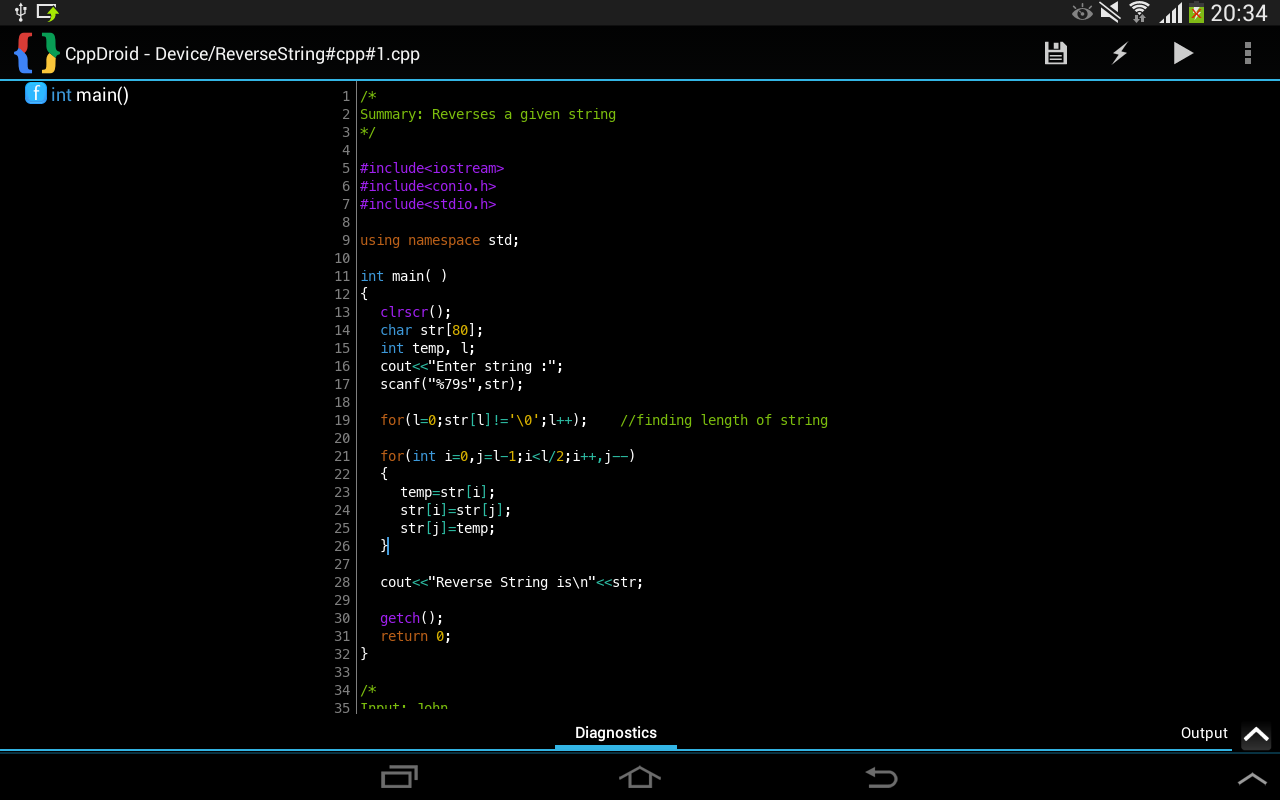
This is another offline compiler but it is freeware app. Rooting is not required. You don't have to pay for it. It is designed for educational purposes as the developer says, "CppDroid is simple C/C++ IDE focused on learning programming languages and libraries".

CppDroid - C/C++ IDE - compiler application for Android mobile phones
Features:
  • real-time diagnostics (warnings and errors) and fixes
  • syntax highlighting
  • portrait or landscape UI
  • C/C++ code examples and guides
  • GUI customisation with themes


C Compiler

A very simple and basic C compiler for Android phones. Not many features.

Find it in Google playstore